Jeff Bezos Reportedly Wants $100 Billion to Transform Old Manufacturing Firms with AI
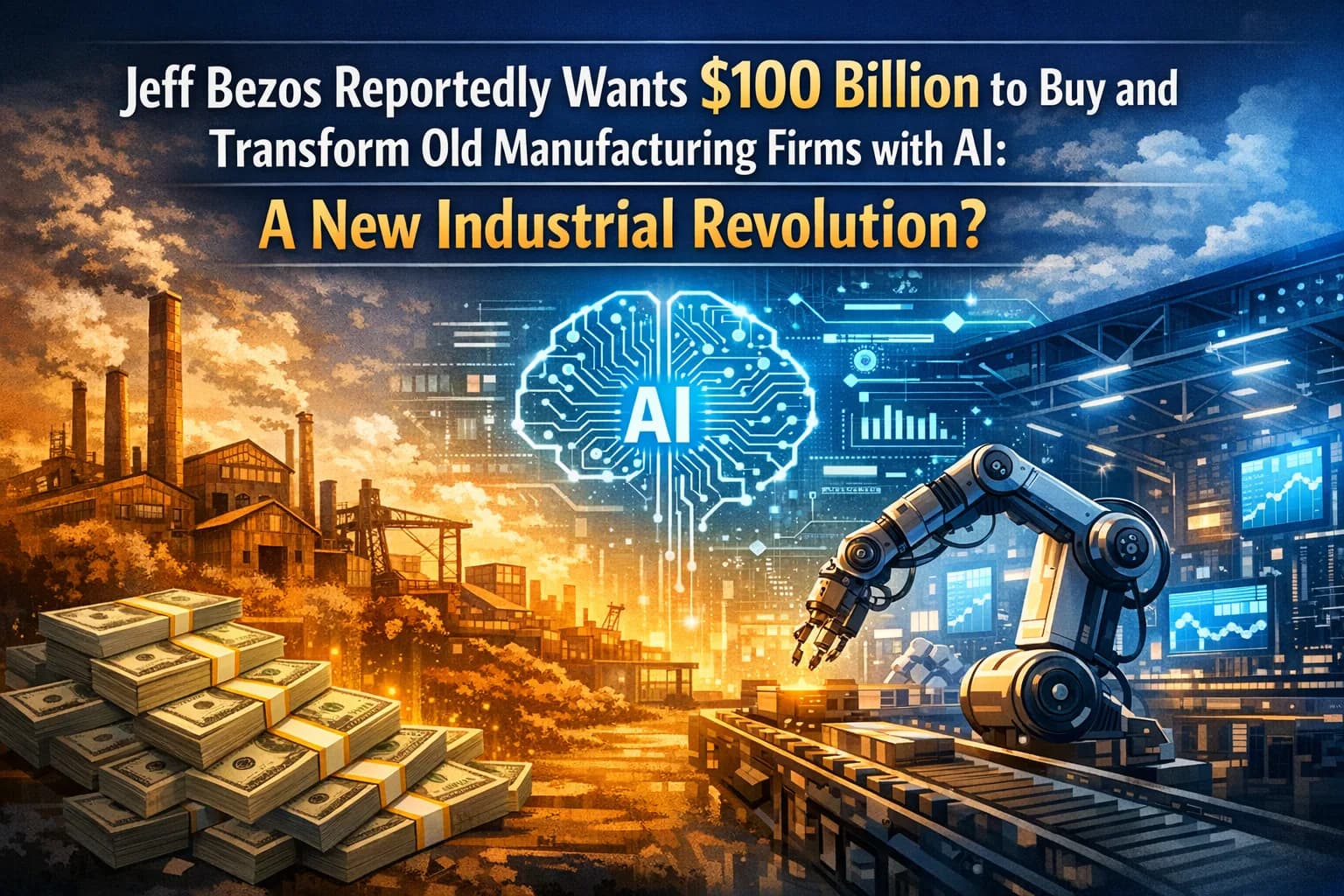
The industrial world is buzzing with a seismic rumor: Jeff Bezos reportedly wants $100 billion to buy and transform old manufacturing firms with AI. This audacious vision, if realized, could ignite an unprecedented wave of innovation, pulling legacy industries out of the analog age and into a hyper-efficient, data-driven future. It's a proposition that merges colossal capital with cutting-edge artificial intelligence, aiming to revitalize the backbone of global economies: manufacturing.
For decades, many traditional manufacturing sectors have grappled with aging infrastructure, slow adoption of new technologies, and a workforce often unprepared for the digital era. Bezos, known for his relentless pursuit of efficiency and disruption across industries, appears to be eyeing this vast, untapped potential. His reported interest isn't just about financial investment; it's about a fundamental reimagining of how goods are made, distributed, and consumed.
 The transformation would likely begin with an assessment of existing operations, identifying bottlenecks and areas ripe for AI intervention. Subsequently, a roadmap for digitalization would be implemented, involving:
 Societally, the shift would necessitate a massive investment in workforce training and education. Programs designed to reskill workers for roles in a smart factory environment would be crucial. Governments and educational institutions would need to collaborate with industry to prepare the next generation for an AI-integrated economy. This isn't just about replacing old machines; it's about empowering people with new skills for an evolving industrial landscape. Such initiatives could pave the way for a more resilient and adaptable global workforce, as discussed in numerous reports on the future of work.
The Grand Vision: Bezos's AI-Driven Industrial Transformation
Imagine factories where every machine communicates, every process is optimized in real-time by algorithms, and production lines adapt autonomously to demand fluctuations. This isn't science fiction; it's the future that Bezos's reported initiative seeks to accelerate. The $100 billion figure isn't merely a large sum; it signifies a commitment to comprehensive overhaul, from the factory floor to the supply chain, leveraging AI's full spectrum of capabilities. This potential investment could target a diverse range of manufacturing sectors, from heavy industry and automotive to textiles and consumer goods. The goal would be to acquire these firms, inject significant capital for technological upgrades, and embed AI at every operational layer. This includes everything from predictive maintenance on machinery to advanced robotics, quality control systems, and complex supply chain optimization.
The transformation would likely begin with an assessment of existing operations, identifying bottlenecks and areas ripe for AI intervention. Subsequently, a roadmap for digitalization would be implemented, involving:
- Installation of IoT sensors for real-time data collection.
- Deployment of AI models for predictive analytics, forecasting, and decision-making.
- Integration of advanced robotics and automation systems for repetitive or hazardous tasks.
- Development of digital twins to simulate and optimize factory layouts and processes.
- Upskilling and reskilling the existing workforce to operate and manage AI-powered systems.
Why Old Manufacturing Firms are Ripe for AI Integration
The choice to target "old manufacturing firms" is strategic. These companies often possess decades of operational experience, established market presence, and valuable institutional knowledge. However, they frequently suffer from:- Outdated Infrastructure: Machines running on legacy systems, leading to inefficiencies and breakdowns.
- Manual Processes: Reliance on labor-intensive tasks that are prone to human error and slower production speeds.
- Inefficient Supply Chains: Lack of real-time visibility and reactive rather than proactive management.
- Limited Data Utilization: Abundance of operational data that remains unstructured and unanalyzed.
Practical Applications of AI in Revitalized Factories
The potential applications of AI across various facets of manufacturing are immense:- Predictive Maintenance: AI algorithms can analyze data from sensors on machinery to predict failures before they occur, scheduling maintenance proactively and minimizing costly downtime. This shifts from reactive repairs to preventative care, significantly extending equipment lifespan and ensuring continuous operation.
- Quality Control: AI-powered vision systems can inspect products for defects with far greater speed and accuracy than human eyes, identifying even minute flaws that might otherwise go unnoticed. This leads to higher quality outputs and reduced waste.
- Optimized Production Planning: AI can analyze demand forecasts, inventory levels, and production capacities to create dynamic, optimized schedules, ensuring efficient resource allocation and minimizing bottlenecks.
- Robotics and Automation: Advanced AI-driven robots can perform complex assembly tasks, handle dangerous materials, or operate in extreme environments, increasing safety and productivity. The collaboration between humans and robots (cobots) can also enhance flexibility on the factory floor.
- Supply Chain Management: AI can predict disruptions, optimize logistics routes, manage inventory levels across multiple warehouses, and provide real-time visibility into the entire supply chain, leading to significant cost savings and improved responsiveness. For more on AI's impact, check out TechPerByte's insights on AI innovation.
- Generative Design: AI can assist engineers in designing new products or components by exploring thousands of design iterations based on specific parameters, leading to more innovative and efficient solutions.
Economic and Societal Ripple Effects of Bezos's AI Manufacturing Push
A $100 billion investment to modernize manufacturing firms with AI would send significant economic and societal ripple effects across the globe. Economically, it could:- Boost Productivity: Dramatically increase output per worker and per machine, leading to stronger economic growth.
- Enhance Competitiveness: Allow firms in traditionally high-cost regions to compete more effectively with global manufacturers, potentially leading to reshoring of production.
- Create New Industries and Jobs: While some traditional jobs might be automated, the implementation, maintenance, and development of AI systems will create new roles in data science, robotics engineering, AI ethics, and cybersecurity.
- Drive Innovation: Spur further research and development in AI, robotics, and advanced materials as new challenges and opportunities arise.
Societally, the shift would necessitate a massive investment in workforce training and education. Programs designed to reskill workers for roles in a smart factory environment would be crucial. Governments and educational institutions would need to collaborate with industry to prepare the next generation for an AI-integrated economy. This isn't just about replacing old machines; it's about empowering people with new skills for an evolving industrial landscape. Such initiatives could pave the way for a more resilient and adaptable global workforce, as discussed in numerous reports on the future of work.
Navigating the Challenges: From Capital to Culture
While the prospect of revitalizing manufacturing with AI is exciting, the journey is fraught with challenges. The sheer scale of the rumored $100 billion investment underscores the capital intensity required. Beyond financing, other hurdles include:- Workforce Transition: Managing the shift from manual labor to supervisory and technical roles for existing employees will require extensive training and change management.
- Data Security and Privacy: AI systems rely heavily on data, making robust cybersecurity measures paramount to protect sensitive operational and proprietary information.
- Ethical AI Deployment: Ensuring that AI systems are fair, transparent, and don't exacerbate existing inequalities is a complex ethical consideration.
- Integration Complexity: Marrying new AI systems with existing legacy infrastructure can be incredibly challenging, requiring specialized expertise and careful planning.
- Market Acceptance: While efficiency gains are clear, consumer and market acceptance of AI-driven products and services also needs consideration.