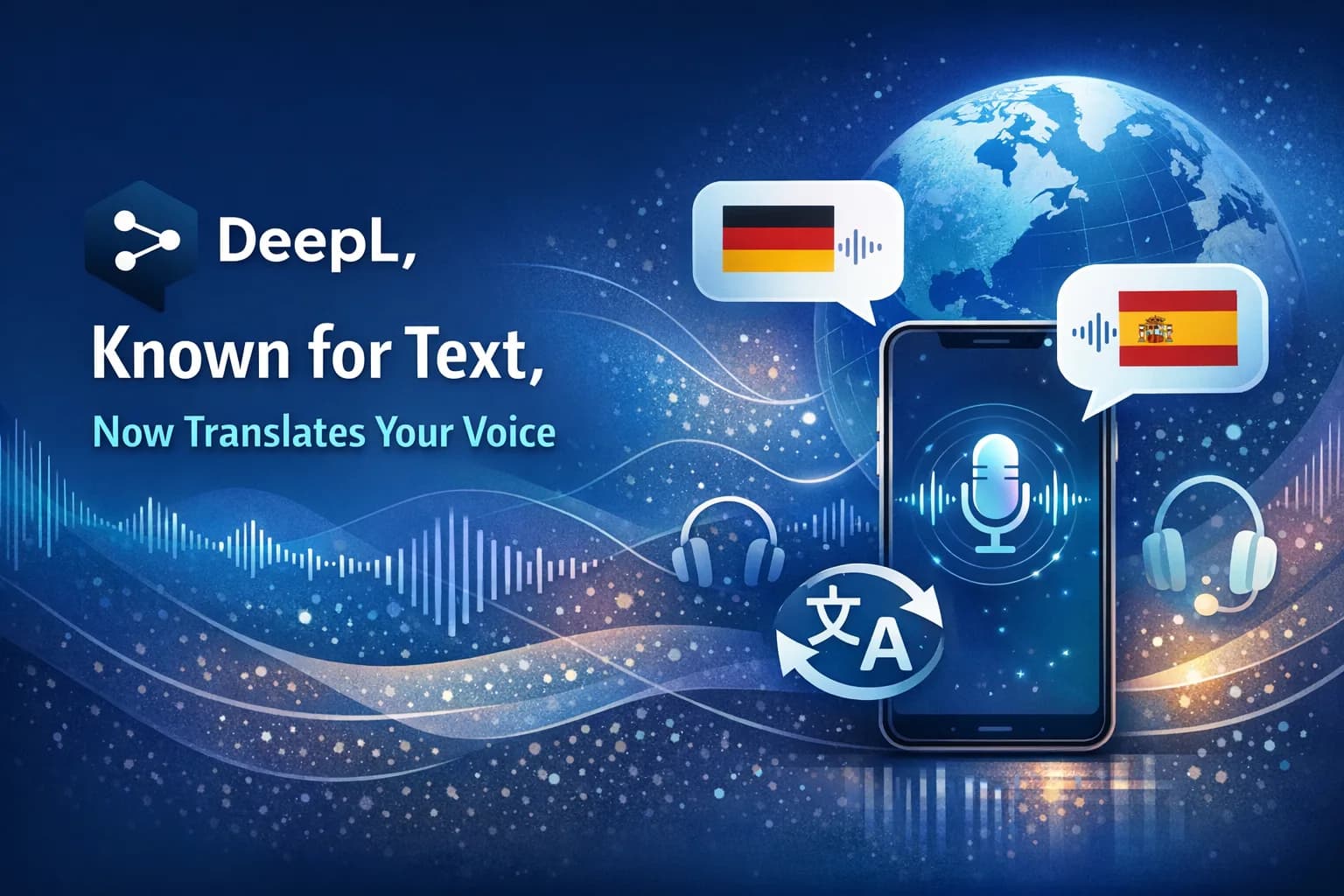
DeepL, Known for Text, Now Translates Your Voice
For years, DeepL has stood out in the crowded field of translation services, earning a reputation for its remarkably accurate and contextually nuanced text translations. From technical documents to casual conversations, its sophisticated AI has consistently delivered results that often surpass those of its competitors. Now, in a bold and highly anticipated move, DeepL, known for text translation, now wants to translate your voice, signaling a significant evolution in its mission to break down language barriers. This new venture promises to transform how we communicate globally, moving beyond the written word to real-time spoken interactions.
This expansion into voice translation isn't just an incremental update; it's a strategic leap that leverages DeepL's core strengths in artificial intelligence and natural language processing. The implications for international business, travel, education, and even personal communication are profound. Imagine conversing with someone in a different language, both speaking naturally, while DeepL seamlessly translates your words in real-time. This is the future DeepL is aiming to create.
 This multi-stage process requires immense computational power and finely tuned models that learn from vast datasets. DeepL’s reputation for natural-sounding translations in text gives us strong reason to believe its voice output will similarly strive for a conversational quality, avoiding the robotic inflexibility often associated with early voice synthesis. The ambition is to make language barriers almost imperceptible, fostering genuine understanding rather than mere word-for-word exchanges. For more insights into such advanced AI, you can explore resources like TechCrunch.
 The success of this venture hinges on DeepL's ability to deliver consistent, high-quality translation that feels natural and unobtrusive. If achieved, it could significantly impact global communication, fostering greater understanding and collaboration. This advancement moves us closer to a world where language is no longer a barrier but a bridge. For more on cutting-edge language AI, check out The Verge's tech section.
The Journey from Text Mastery to Voice Innovation
DeepL's success has been largely attributed to its unique neural network architecture, which allows it to understand context and nuance far better than many rule-based or statistical machine translation systems. This deep understanding of language, which includes idioms, slang, and cultural references, has been a game-changer for text translation users worldwide. Transitioning this expertise to voice presents a new set of challenges, but also immense opportunities. The company has meticulously built its foundation on accuracy, and this commitment is expected to extend to its voice offerings. While many services offer voice translation, DeepL's entry suggests a focus on quality and naturalness that could set a new industry standard. The demand for seamless, accurate voice translation has never been higher, driven by a globalized economy and increasingly interconnected societies. DeepL’s foray into this domain is not just timely but potentially revolutionary.How DeepL's Voice Translation Works: A Glimpse Behind the AI
The magic behind DeepL's acclaimed text translation lies in its sophisticated AI and machine learning models, specifically its use of convolutional neural networks. For voice translation, this technological backbone gets even more complex, integrating speech recognition, translation, and speech synthesis into a fluid, real-time process. When DeepL, known for text translation, now wants to translate your voice, it's not simply converting sounds into text and then back into sounds; it's an intricate dance of algorithms designed to capture meaning, tone, and context on the fly. Initially, the system must accurately transcribe spoken language into text – a task fraught with challenges like accents, dialects, background noise, and varying speech rates. Once accurately transcribed, DeepL's renowned translation engine takes over, converting the source language into the target language with its characteristic precision and natural flow. Finally, the translated text is converted back into spoken words using advanced text-to-speech (TTS) technology, aiming for voices that sound as natural and human-like as possible.
This multi-stage process requires immense computational power and finely tuned models that learn from vast datasets. DeepL’s reputation for natural-sounding translations in text gives us strong reason to believe its voice output will similarly strive for a conversational quality, avoiding the robotic inflexibility often associated with early voice synthesis. The ambition is to make language barriers almost imperceptible, fostering genuine understanding rather than mere word-for-word exchanges. For more insights into such advanced AI, you can explore resources like TechCrunch.
DeepL, known for text translation, now wants to translate your voice for global connectivity
The practical applications of real-time voice translation are virtually limitless, impacting various sectors and everyday interactions. When DeepL, known for text translation, now wants to translate your voice, it unlocks new possibilities for global communication previously hindered by linguistic differences.- International Business Meetings: Imagine seamless communication during video conferences or in-person meetings with international partners. No more awkward pauses for interpreters, just natural dialogue flowing in real-time, allowing participants to focus on content rather than translation mechanics.
- Travel and Tourism: Tourists can navigate foreign countries with greater ease, conversing with locals, ordering food, or asking for directions without fear of misunderstanding. This enhances cultural exchange and personal safety.
- Education and Language Learning: Students can access lectures and collaborate with peers from around the world, breaking down academic barriers. Language learners can practice speaking with native speakers, receiving instant feedback through accurate translations.
- Healthcare: Medical professionals can communicate more effectively with patients who speak different languages, ensuring better diagnoses and care, especially in critical situations.
- Personal Communication: Staying connected with friends and family across linguistic divides becomes simpler, fostering stronger personal relationships and broader social networks.
Addressing Challenges and Realizing the Promise of Voice AI
While the promise of perfect real-time voice translation is incredibly exciting, the technical challenges are significant. Accents, dialects, rapid speech, background noise, emotional inflections, and specific jargon can all complicate accurate speech recognition and translation. Furthermore, maintaining the natural flow and rhythm of conversation while translating requires immense processing power and highly sophisticated algorithms that can predict and adapt. DeepL’s reputation for contextual accuracy in text gives it a strong starting point. Its ability to grasp nuances is crucial for voice, where misunderstanding a single word can alter the entire meaning of a sentence. The company will likely employ advanced noise reduction techniques and models trained on vast, diverse datasets of spoken language to overcome these hurdles. The goal isn't just to translate words, but to convey intent and emotion, which is a much higher bar.
The success of this venture hinges on DeepL's ability to deliver consistent, high-quality translation that feels natural and unobtrusive. If achieved, it could significantly impact global communication, fostering greater understanding and collaboration. This advancement moves us closer to a world where language is no longer a barrier but a bridge. For more on cutting-edge language AI, check out The Verge's tech section.