Microsoft, Google, Amazon Confirm Anthropic Claude Remains Available to Non-Defense Customers
In a move designed to alleviate market uncertainty and underscore a commitment to responsible AI deployment, a joint clarification has emerged from the tech industry's leading hyperscalers. Giants like Microsoft, Google, and Amazon have jointly affirmed their position, letting it be known that
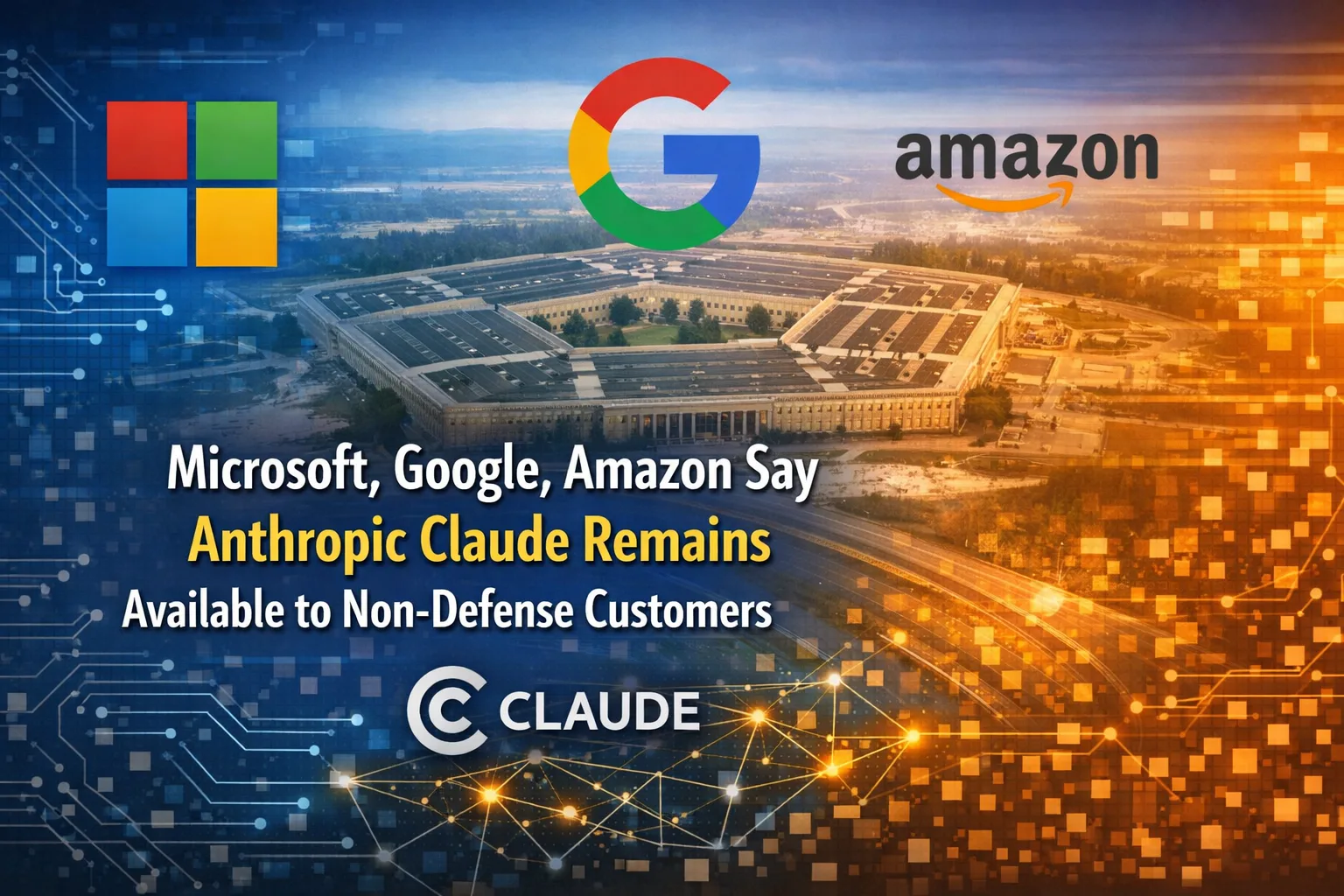
Microsoft, Google, Amazon say Anthropic Claude remains available to non-defense customers. This pivotal announcement is more than just a public statement; it's a strategic reassurance to the vast ecosystem of businesses, developers, and organizations eager to leverage advanced artificial intelligence without concerns about its application in sensitive defense sectors.
The landscape of artificial intelligence is rapidly evolving, bringing with it both immense opportunity and complex ethical considerations. As powerful AI models like Anthropic's Claude gain increasing sophistication, questions naturally arise about their potential dual-use capabilities. This collective declaration from the world's largest cloud providers—who also serve as key partners and investors in AI development—provides much-needed clarity. It firmly establishes boundaries, reinforcing the intent to channel Claude's advanced capabilities towards innovation and productivity across civilian industries, rather than military applications. For businesses planning their AI strategies, this means a stable and predictable environment for adopting cutting-edge AI technology.


Clearing the Air: Why This Clarification Matters for AI Adoption
Recent years have seen an increasing global discourse around the ethics and governance of artificial intelligence, particularly concerning its potential for military or defense applications. As AI models become more potent, the line between beneficial civilian use and potential military application can sometimes appear blurred, leading to apprehension among developers, investors, and end-users alike.Addressing Dual-Use Concerns with a Unified Front
Anthropic, the developer of the Claude AI model, has consistently championed a "Constitutional AI" approach, emphasizing safety, transparency, and ethical guardrails from its inception. This philosophy is centered on developing AI that is helpful, harmless, and honest. The recent announcement by Microsoft, Google, and Amazon serves to publicly align these major tech players with Anthropic's principled stance. By clearly stating that Anthropic Claude remains accessible for non-defense customers, they are collectively sending a powerful message about the intended trajectory of this advanced AI. This collaborative effort helps to mitigate the speculative fears that often accompany rapidly advancing technologies, allowing enterprises to invest in AI solutions with greater confidence. For organizations navigating the complexities of AI integration, this clarification from such authoritative sources is invaluable. It reduces the risk profile associated with adopting powerful large language models, ensuring that their AI investments are aligned with global best practices for ethical technology use. Businesses can now proceed with greater certainty, knowing that the foundational AI tools they plan to deploy are being steered away from contentious applications, reinforcing a commitment to responsible innovation.Anthropic Claude: A Powerhouse for Non-Defense Applications
Anthropic's Claude is renowned for its sophisticated reasoning, contextual understanding, and robust safety features. It represents a significant leap in AI capabilities, offering solutions that extend far beyond basic task automation. The decision by Microsoft, Google, and Amazon to affirm that Microsoft, Google, Amazon say Anthropic Claude remains available to non-defense customers isn't just about limiting use cases; it's about empowering a wide array of non-defense sectors to harness its full potential for transformative change.Understanding Claude's Capabilities
Claude distinguishes itself through its ability to handle complex prompts, maintain long conversations, and exhibit advanced logical reasoning. It excels at tasks requiring nuanced understanding, such as synthesizing vast amounts of information, generating creative content, summarizing intricate documents, and providing detailed coding assistance. Crucially, its "Constitutional AI" training imbues it with a higher degree of safety and steerability, making it particularly well-suited for sensitive enterprise environments where reliability and ethical performance are paramount. This makes it an ideal partner for businesses looking to enhance productivity, improve decision-making, and innovate without compromising on core values.Real-World Business Advantages
The applications for Claude in non-defense sectors are virtually limitless, offering tangible benefits across diverse industries:- Customer Service & Support: Claude can power next-generation chatbots and virtual assistants, providing more accurate, empathetic, and personalized responses. This can significantly reduce response times, resolve complex queries, and free up human agents for more intricate issues, leading to higher customer satisfaction and operational efficiency.
- Content Creation & Marketing: From drafting blog posts and marketing copy to summarizing research papers and generating social media content, Claude can dramatically accelerate content pipelines, ensuring consistent quality and brand voice.
- Data Analysis & Insights: Businesses can leverage Claude to process and interpret large datasets, extracting meaningful insights, identifying trends, and supporting strategic decision-making in areas like market research, financial forecasting, and operational optimization.
- Software Development & IT: Developers can use Claude for code generation, debugging, documentation, and even translating legacy code, thereby speeding up development cycles and improving code quality.
- Healthcare & Life Sciences: Claude can assist with administrative tasks, analyze medical literature, help synthesize research findings, and support drug discovery processes, all while adhering to strict ethical and privacy guidelines.
- Legal & Compliance: The model can aid in reviewing legal documents, identifying relevant clauses, summarizing case law, and ensuring compliance with regulatory frameworks, significantly reducing the manual effort involved in these critical processes.
The Hyperscalers' Commitment: Microsoft, Google, Amazon's Unified Message
The joint statement from Microsoft, Google, and Amazon regarding Claude's availability to non-defense customers is not just an arbitrary decision; it reflects a deeper strategic alignment and a shared vision for the future of AI. Each of these tech behemoths plays a critical role in bringing advanced AI to the masses, and their unified message reinforces market stability and confidence.Microsoft's Azure AI and Claude
Microsoft, through its extensive Azure AI platform, offers a comprehensive suite of AI services and infrastructure. Their collaboration with Anthropic, including making Claude available through Azure, demonstrates a commitment to providing their enterprise customers with access to the most advanced models. This means Azure users can leverage Claude's capabilities with the robust security, scalability, and compliance features that Azure is known for. Businesses already operating within the Azure ecosystem can seamlessly integrate Claude into their existing applications and workflows, enhancing their operations with cutting-edge conversational AI.Google Cloud and Anthropic's Partnership
Google has been a significant investor in Anthropic, signaling a strong belief in their approach to AI development. The partnership extends to making Claude available on Google Cloud, providing GCP users with access to this powerful model. This strategic alliance highlights Google's dedication to fostering an open, innovative, and responsible AI ecosystem. For companies utilizing Google Cloud, this translates into flexible deployment options, integration with other Google AI services, and the ability to build sophisticated, Claude-powered applications on a global, secure infrastructure. More information on Anthropic's principled approach can be found on their official website, detailing their commitment to safety and ethics.Amazon Web Services (AWS) and AI Integration
Amazon, through AWS, offers Amazon Bedrock, a fully managed service that provides access to foundation models (FMs) from leading AI companies, including Anthropic. The integration of Claude into Bedrock signifies AWS's commitment to offering a broad choice of models to its vast customer base. This allows businesses on AWS to easily experiment with and deploy Claude, integrating it with other AWS services like Amazon Sagemaker for custom machine learning workflows. The endorsement from AWS further solidifies the market position of Claude as a trusted and accessible AI model for a wide range of civilian applications. The collective emphasis from these three global leaders—that Microsoft, Google, Amazon say Anthropic Claude remains available to non-defense customers—is a powerful testament to the industry's focus on responsible AI development and its immense potential to drive positive change across non-military sectors. It creates a stable foundation for enterprises worldwide to confidently embark on their AI transformation journeys.Navigating the AI Landscape: Implications for Enterprise Adoption
The explicit assurance from Microsoft, Google, and Amazon that Anthropic Claude is specifically for non-defense customers creates a ripple effect of positive implications for enterprise AI adoption. This clarity is not merely a formality; it directly impacts market stability, trust, and the pace of innovation across industries. Firstly, it injects a significant dose of market stability. Businesses often hesitate to invest heavily in emerging technologies, especially when there's ambiguity surrounding their ethical use or future regulatory landscape. By drawing a clear line, the tech giants reduce this uncertainty, allowing enterprises to plan their long-term AI strategies with greater confidence. This predictable environment encourages more aggressive investment in AI infrastructure, talent, and solution development, knowing that the core tools are aligned with broader societal values. Secondly, it bolsters trust and reinforces the ethical dimensions of AI. In an era where data privacy and algorithmic bias are paramount concerns, an explicit commitment to non-defense applications aligns Claude with principles of transparency and beneficial use. This resonates deeply with enterprises that are increasingly prioritizing corporate social responsibility and ethical governance. For organizations building customer-facing AI applications, this assurance can be a powerful differentiator, fostering greater trust with their own end-users. Furthermore, this commitment accelerates innovation. With the ethical framework clearly defined, developers and businesses can focus their efforts entirely on creating solutions that address civilian needs. This could lead to breakthroughs in areas like personalized education, advanced medical diagnostics, sustainable resource management, and efficient urban planning. The absence of "dual-use" complexities simplifies development cycles and encourages a broader range of talent to engage with these powerful AI models. To understand how to best integrate such powerful tools into your business, exploring practical enterprise AI strategies can be highly beneficial.